Three weeks apart this fall, two neighboring cities presented their water departments' plans for the same federal cuts. At a City Council work-study session on October 20, 2026, Scottsdale Water described a potential 17% reduction to the city's Colorado River allocation for 2027. On November 10, the City of Phoenix said it expects to enter Stage 2 of its Drought Management Plan in January, with a voluntary cutback request and a surcharge for the heaviest water users.
If you're weighing a move here and keep hearing that Arizona is running out of water, those two meetings answer more than the headlines do. Scottsdale's own figures show the city drew well under its full Colorado River allocation in 2025, and that gap absorbs much of a 17% cut. For homes near the Scottsdale–Phoenix line, the more useful question is which city's utility serves the address.
The Federal Cut Behind Both Meetings
The Bureau of Reclamation issued its Record of Decision on post-2026 Colorado River operations on August 21, 2026, after the seven basin states did not agree on long-term rules. It released 2027–2028 Operating Guidelines at the same time. As Western Water reported in October, those guidelines cut deliveries to Arizona, California and Nevada by a combined 1.25 million acre-feet in each of 2027 and 2028. Under a proposed sharing agreement among those states, Arizona would absorb 760,000 acre-feet of that cut each year. One acre-foot is about 326,000 gallons.
The Central Arizona Project's Colorado River conditions dashboard, based on Reclamation's October 2026 24-Month Study, shows Lake Mead in a shortage condition with the 1.25 million acre-foot Lower Basin reduction in calendar 2027. It projects another shortage for 2028. KJZZ reported on November 12 that if the three-state deal comes together before January, Arizona's share of Colorado River water would drop by roughly 27% and CAP's deliveries by roughly 50%.
These numbers are why "running out of water" headlines keep appearing. Scottsdale gets about two-thirds of its water supply through CAP, so the Valley-wide CAP cut can sound like a two-thirds problem for every Scottsdale tap. The city's own estimate is much smaller than that.
The Gap Between Scottsdale's Allocation and Its Actual Use
Scottsdale's October 20 presentation puts the city's CAP rights at 81,271 acre-feet a year and shows the potential 17% reduction for 2027 beside that allocation. Applied to the full allocation, a 17% cut leaves roughly 67,500 acre-feet.
The same presentation lists the city's CAP deliveries for calendar 2025 at 62,500 acre-feet, about 77% of the allocation. Scottsdale hasn't been drawing its full entitlement, so much of a cut measured against that entitlement falls on water the city wasn't taking. A 17% cut to a paycheck feels different when the household was only spending 77% of it.
Here is the city's full mix for 2025, from the same presentation:
| 2025 source | Acre-feet delivered |
|---|---|
| CAP (Colorado River) | 62,500 |
| SRP (Salt and Verde rivers) | 12,700 |
| Reclaimed water | 8,200 |
| Groundwater | 7,400 |
| Total, including reclaimed | 90,800 |
The 17% figure is Scottsdale Water's potential estimate as of October 20, not a final delivery order. The city's Water Shortages and Preparedness page lists Scottsdale at Stage One of its Drought Management Plan.
The Arizona Canal Line Across Scottsdale
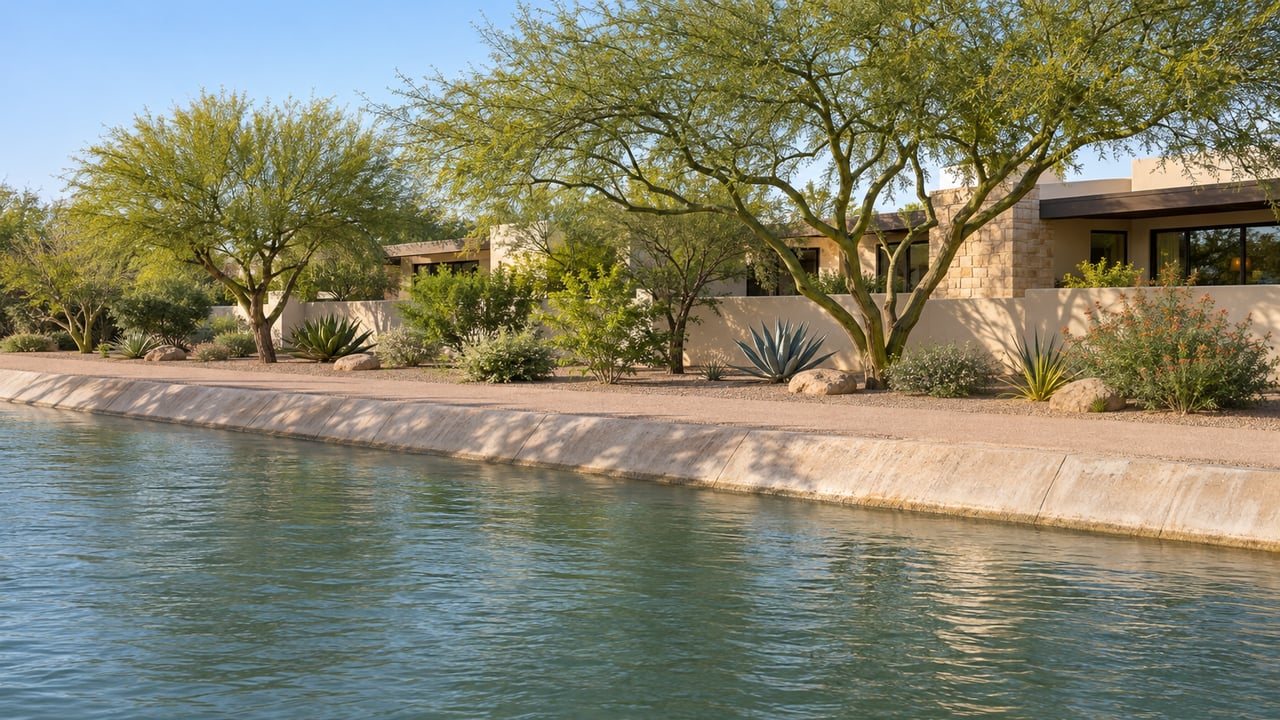
Scottsdale's water comes from different places on either side of the city. Water from the Salt River Project reaches Scottsdale through the Arizona Canal and is treated at the Chaparral Water Treatment Plant near McDonald Drive and Hayden Road, and the city's page says that supply goes to the parts of Scottsdale south of the canal. CAP water reaches the whole service area. It is treated at the 70-million-gallon-a-day CAP Water Treatment Plant at the Water Campus in north Scottsdale.
So south Scottsdale has a second surface-water source, and homes north of the canal depend on CAP plus whatever the city has stored underground. That stored water is the other half of Scottsdale's preparation. According to the city's Advanced Water Purification page, the Advanced Water Treatment Facility at the Water Campus can purify up to 20 million gallons of recycled water a day. The city recharges nearly two billion gallons of that water into the aquifer each year, and more than 70 billion gallons since 1988. In 2019 Scottsdale received Arizona's first permit for direct consumption of ultra-purified water. The city says it is not yet sending that water into the drinking-water system. It is also building four Aquifer Storage and Recovery wells, which will store treated drinking water underground in the low-demand late fall and winter months and pump it back during high demand or emergencies.
Homes on the Phoenix Side of the Line
Phoenix Water Services points residents to its official service-area map to confirm their provider by address. That lookup matters around 85254, the zip code we looked at in our post on the Scottsdale zip code that answers to Phoenix. Phoenix counts its Paradise Valley Village, which includes the Paradise Valley Mall area, as part of the city.
Phoenix's situation is different from Scottsdale's. In its November 10 announcement, the city said about 40% of its drinking water comes from the Colorado River and that those deliveries could fall by about 30%. The Stage 2 plan asks residents and businesses to cut water use voluntarily by 5% and city departments by 10%. It also includes a temporary drought surcharge for higher-volume customers, which Phoenix estimates would show up on about 16% of residential monthly bills at current usage. The November 10 council item was listed for information and discussion. The Stage 2 plan also raises Phoenix's grass-removal incentive from $2 to $4 per square foot and its smart irrigation controller incentive from $75 to $150, and it adds a $100-a-year leak-repair incentive.
For a buyer comparing a home served by Phoenix Water with one served by Scottsdale Water a few miles away, that's a real difference. Both cities draw on the same river and face the same federal cut, but they head into 2027 with different drought plans and different conservation incentives for a large lawn. Farther east, Mesa Mayor Mark Freeman said in an August 7 report carried by WWNO and NPR that his city expects its supply to fall about 20%. Each Valley utility starts 2027 from its own numbers.
What Scottsdale Water Already Costs
For homes on Scottsdale Water, the price change for this winter is already set. Scottsdale Progress reported that the City Council voted unanimously on May 19, 2026 for a 4.5% water rate increase starting November 1, 2026, along with a 3.5% wastewater increase that took effect July 1. The city publishes its full rate schedules on its water rates and fees page. These figures are general information, not legal, tax or financial advice. Confirm what applies to a specific property with the utility and the right professional.
If you're looking at a pool home, our guide to Scottsdale pool home costs covers the rest of the ownership math.
Questions Buyers Raise About Scottsdale Water
Where would Scottsdale post any change for 2027? Scottsdale's Colorado River update says the city will keep providing reliable service and is preparing for a range of possible conditions. Any change for 2027 would come from the city, and that page is where it would be posted.
Is 2027 a one-year event? The federal guidelines cover both 2027 and 2028, and CAP's dashboard projects a shortage condition in 2028 as well.
How do I know which utility serves a home I'm considering? Look up the street address on Phoenix's service-area map, which checks the provider by street address.
Which city's water reaches a home is worth knowing as early as the floor plan and the lot. If you're weighing a home in 85254 or anywhere else in Scottsdale and want to know which water system serves it, Jaime Fernandez can check the property with you before you write an offer. Thinking of selling instead? Request Your Free Home Valuation to see what your Scottsdale home is worth heading into 2027.