If you are looking at Scottsdale single-family rentals as a long-term investment, you are probably asking the right hard question first: Will the numbers and the market support a buy-and-hold strategy here? That is a smart place to start, because Scottsdale is not usually a plug-and-play cash flow market. It is a premium, high-cost city where investor success often depends on buying the right home, understanding local rules, and holding with patience. Let’s break down what makes Scottsdale different and what you should pay attention to before you buy.
Scottsdale rental investing starts with the big picture
Scottsdale is a large, high-income city with an active housing market and a meaningful renter base. Census estimates for 2024 show 246,170 residents, 118,637 households, a 67.0% owner-occupied rate, median household income of $110,886, and median gross rent of $2,013. That tells you two things at once: homeownership is dominant, but long-term rental demand is still very real.
The challenge for investors is the cost of entry. Scottsdale’s 2025 Housing Needs Assessment puts the 2024 median single-family home value at $1,125,000, up from $767,000 in 2020. The same report estimates that a household would need about $312,000 in annual income to afford that median single-family price, which helps explain why well-qualified renters remain part of the housing mix.
Why Scottsdale attracts long-term renters
Long-term tenant demand in Scottsdale is tied closely to employment, relocation, and lifestyle. The city describes itself as one of Arizona’s leading job centers, with almost 34,000 companies doing business locally and more than 200,000 jobs supported by Scottsdale employers. The FY2024-25 annual report says businesses and organizations in Scottsdale have 211,885 employees, and more people commute into Scottsdale for work than leave it.
That matters if you are investing in a single-family rental. Job centers help create steady demand from professionals, executives, and relocating households who want more space, privacy, parking, or outdoor living than many apartment options can offer.
The city also points to key employment and activity areas such as SkySong, Old Town Scottsdale, Scottsdale Airpark, the Cure Corridor, and Scottsdale Fashion Square. Healthcare and finance firms are among the leading employers. For many renters, proximity to work and access to dining, retail, and daily conveniences can matter just as much as the house itself.
Scottsdale supports a higher-income renter pool
Scottsdale’s resident profile adds another layer of support for long-term rentals. Census data shows 61.9% of adults have a bachelor’s degree or higher, 96.2% of households have broadband, 98.3% have a computer, and the mean travel time to work is 21.6 minutes. These indicators suggest a renter pool that includes working professionals, remote or hybrid workers, and households that may prioritize home functionality.
Another useful data point is stability. Census estimates say 84.2% of people lived in the same house one year earlier. While that statistic is not limited to renters, it still supports the idea that Scottsdale can appeal to residents looking for a longer-term fit rather than a short stopover.
Yield expectations in Scottsdale single-family rentals
This is where investor expectations need to be realistic. Rentometer’s June 2026 Scottsdale data shows average rents of $3,282 for 2-bedroom houses, $4,356 for 3-bedroom houses, and $6,152 for 4+ bedroom houses. For 3-bedroom houses, the median is $3,500 per month.
Using the city median single-family value of $1,125,000, the average 3-bedroom rent implies roughly a 4.6% gross yield before taxes, insurance, maintenance, vacancy, and management costs. That is not a final underwriting metric, but it helps explain the market clearly. Scottsdale is often better suited to investors who value long-term appreciation, asset quality, and tenant stability more than immediate cash flow.
What homes tend to perform best
In Scottsdale, broad tenant appeal matters. Single-family rentals often compete best when they offer flexible layouts, enough bedrooms for shared use or a home office, garage or covered parking, and usable outdoor space. In a market with higher rents, tenants often expect a home that feels functional and comfortable, not just well located.
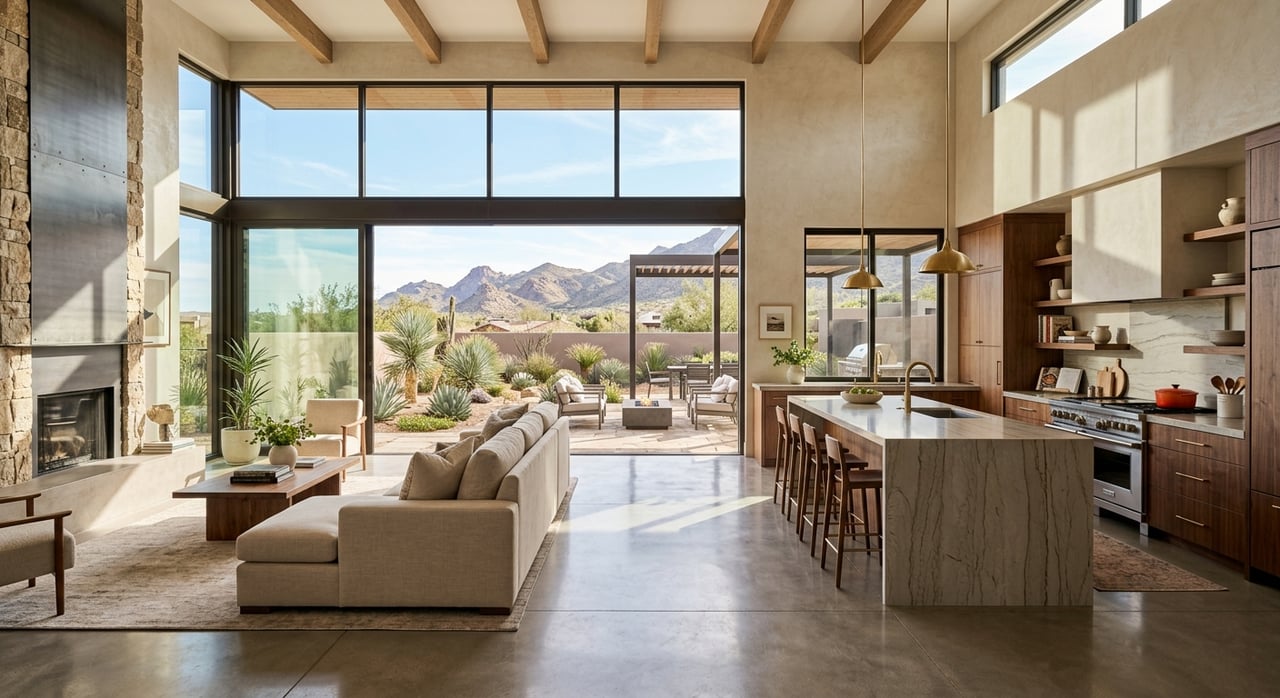
Outdoor living also carries extra weight here. Scottsdale highlights its weather, desert setting, resorts, spas, dining, and golf amenities as part of the local lifestyle. Features like shade, patio space, pools, and strong indoor-outdoor flow can help a home stand out in the leasing market.
In practical terms, many investors focus on homes that check several of these boxes:
- 3 or more bedrooms
- Flexible bonus space for office or guest use
- Garage or covered parking
- Low-maintenance but attractive outdoor areas
- Good access to major employment and lifestyle nodes
- Solid overall condition with fewer near-term capital surprises
A key Scottsdale rule on guest houses
If you are considering a property with a guest house, be careful with your income assumptions. Scottsdale says a guest house may not be rented separately from the main single-family residence. That means you should not underwrite a guest house as a standalone rental unit when evaluating a single-family property.
This is an important example of why local rule review matters before you buy. A property can look more profitable on paper if you assume extra rental income that local rules do not actually allow.
Arizona and Maricopa County rules to know
Long-term landlords in Scottsdale should understand a few basic compliance points from the start. Arizona’s Residential Landlord and Tenant Act applies to houses and apartments. Under A.R.S. 33-1321, a landlord may not demand more than 1.5 months’ rent as security, and any nonrefundable fees must be identified in writing.
After move-out, the landlord must send an itemized list of deductions and any amount due within 14 days, excluding Saturdays, Sundays, and legal holidays, after termination, possession, and tenant demand. Arizona courts also note that landlords must keep premises fit and habitable and generally give 2 days’ written notice before entry unless there is an emergency or the tenant has requested repairs.
There is also a county-level step many investors should build into their process. Maricopa County requires residential rental property to be registered with the County Assessor under A.R.S. 33-1902. It is an administrative requirement, but missing it can create avoidable issues.
Scottsdale tax treatment changed in 2025
Tax treatment is another area where investors need current local information. Scottsdale says residential rental stays longer than 29 consecutive days are no longer taxed as of January 1, 2025. Stays under 30 days remain subject to transient lodging tax.
The city profile from the Arizona Department of Revenue still notes a $2 annual license fee per residential unit, capped at $50. For long-term investors, the big takeaway is simple: long-term rentals and short-term stays do not get treated the same way, so your business plan should match the property’s intended use.
Supply changes may matter over time
Scottsdale remains primarily a low-density, high-cost market, but supply rules are not standing still. The city adopted Ordinance 4687 on September 30, 2025 to expand ADU options on residential lots. It also adopted Ordinance 4690 on November 17, 2025 to comply with Arizona’s middle-housing law, though the city says middle housing is still limited by location exclusions, service requirements, and other standards.
For investors, this does not mean Scottsdale is suddenly becoming an easy supply market. It does mean some areas may see gradual and selective increases in housing options over time. That is worth watching if you are making a long-hold decision based on future competition and neighborhood inventory patterns.
Who Scottsdale single-family rentals fit best
Scottsdale can make sense if you want to own a high-quality asset in a market with strong lifestyle appeal, major employment drivers, and a higher-income resident base. It may be especially appealing if your strategy is centered on preserving capital in a desirable location and letting time do part of the work.
It may be less attractive if you are looking for strong day-one cash flow from a median-priced single-family purchase. The combination of high acquisition costs and relatively moderate gross yields means you need a disciplined underwriting approach and enough margin for repairs, vacancy, and operating costs.
A smart investor approach in Scottsdale
The strongest opportunities are often well-located, well-maintained homes with broad rental appeal and a clear long-term plan. In this market, small mistakes in assumptions can get expensive quickly. Purchase price, rent range, property condition, and local compliance details all deserve close attention.
If you are comparing Scottsdale with other East Valley options, it helps to evaluate each property in context rather than chasing one headline number. A home with better layout, better access, and better long-term tenant appeal may outperform a cheaper option that looks stronger only on a rough spreadsheet.
If you want a local read on which Scottsdale areas, price points, and home features may fit your long-term investment goals, Jaime Fernandez offers tailored guidance backed by deep Scottsdale market knowledge and a concierge-style approach.
FAQs
What makes Scottsdale different for long-term rental investors?
- Scottsdale is generally a premium, appreciation-sensitive market with high home values, solid long-term tenant demand, and thinner gross yields than many cash-flow-focused markets.
What are average Scottsdale house rents by bedroom count?
- Rentometer’s June 2026 data shows average house rents of $3,282 for 2-bedroom homes, $4,356 for 3-bedroom homes, and $6,152 for 4+ bedroom homes.
Are Scottsdale single-family rentals mainly cash-flow investments?
- In many cases, no. Based on local home values and rent levels, Scottsdale often works better as a long-hold strategy than as a pure cash-flow play.
Can you rent out a guest house separately in Scottsdale?
- No. Scottsdale says a guest house may not be rented separately from the main single-family residence.
Do long-term rental stays get taxed in Scottsdale?
- Scottsdale says residential rental stays longer than 29 consecutive days are no longer taxed as of January 1, 2025, while stays under 30 days remain subject to transient lodging tax.
Do Scottsdale landlords need to register rental property?
- Yes. Maricopa County requires residential rental property to be registered with the County Assessor under A.R.S. 33-1902.